26.11.2025
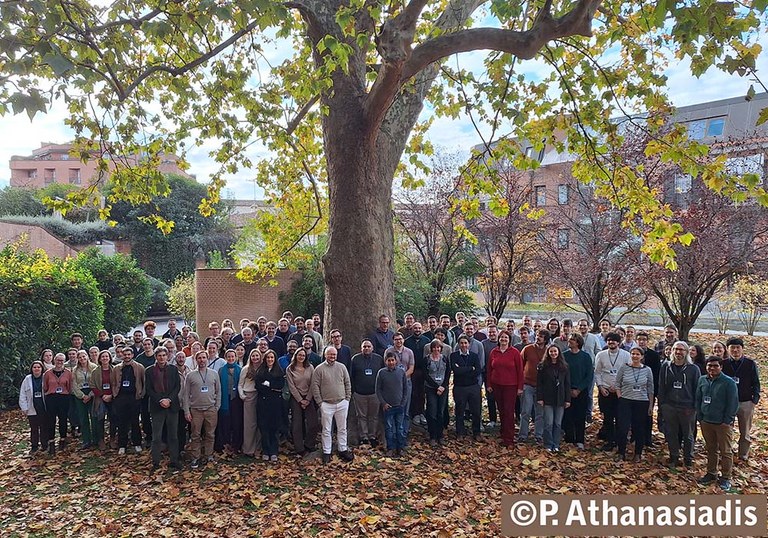
The “Open Workshop on Understanding and Predicting Annual to Multi-Decadal Climate Variations” brought together researchers from the Horizon Europe projects ASPECT, EXPECT, and I4C, as well as the DCPP and EPESC projects of the World Climate Research Program (WCRP) - among them colleagues of DKRZ. The workshop focused on how to improve the understanding and prediction of climate variations and extreme events for the next 1 to 30 years.
Participants presented recent progress in identifying climate drivers, evaluating forecasts, developing new prediction methods, and improving the representation of predictability mechanisms in forecast systems. The event also encouraged new collaborations and showcased innovative tools, including machine learning.
DKRZ contributed by demonstrating how advanced deep-learning tools can support integrated attribution and prediction, especially by improving the quality and usability of observational datasets used for climate model development and evaluation.
Christopher Kadow, head of the DKRZ Data Analysis department, showed how transfer-learning neural networks can improve seasonal-to-annual climate predictions for the North Atlantic–European region. His results illustrated the potential of AI to extract robust signals even from sparse observations.
In a poster contribution, Étienne Plésiat evaluated several deep-learning architectures for filling missing values in two key observational datasets, HadEX-CAM and GPCC. His work highlighted the importance of reliable and complete data for accurate climate monitoring and prediction.
The workshop also offered DKRZ researchers the opportunity to connect with colleagues from different projects. They discussed how DKRZ’s deep-learning tools can be applied across emerging scientific domains to support integrated attribution and prediction in the coming years.
Further information: https://expect-project.eu/news/advancing-climate-understanding-and-predictability-highlights-from-the-2025-upcliv-workshop/