25.03.2026
ICCARUS - the ICON/COSMO/CLM/ART User Seminar – is organized annually by DWD in cooperation with the COSMO consortium, the CLM community, Karlsruhe Institute for Technology, Max Planck Institute for Meteorology, and DKRZ. It is focused on the development and application of numerical models for weather prediction and climate simulations. Topics range from physical parameterizations and data assimilation to ensemble generation and model verification to technical developments of the models.
The 2026 program combined plenary sessions and poster presentations with working group meetings and workshops, and also offered the opportunity for networking and exchange. The schedule provided space for both presenting recent research and discussing practical development challenges.
What stood out was the close link between scientific questions and technical implementation.
DKRZ contributions
The DKRZ team was involved in several parts of the program, contributing to presentations, posters and workshops.
In her invited keynote, Claudia Frauen presented the current status and next steps towards making the ICON model performance-portable across existing and upcoming EuroHPC systems. This work includes a gradual rewrite of ICON components in C++ using the Kokkos portability library and a move towards lower-precision arithmetic. Jan Frederik Engels delivered a second presentation outlining approaches to run ICON efficiently on various machines, from testclusters of emerging architectures to exascale machines. After discussing the performance of ICON’s components and saving energy due to a maximally heterogeneous setup, he showed how a novel configuration for the Full Earth System can leverage Jupiter to run at unprecedented throughput.
The DKRZ team also contributed to the poster session. Julia Duras presented “Mkexp – to Make Experiments”, a tool supporting experiment management. Jan Frederik Engels and Ralf Müller contributed a poster on improving development workflows and strengthening community exchange.

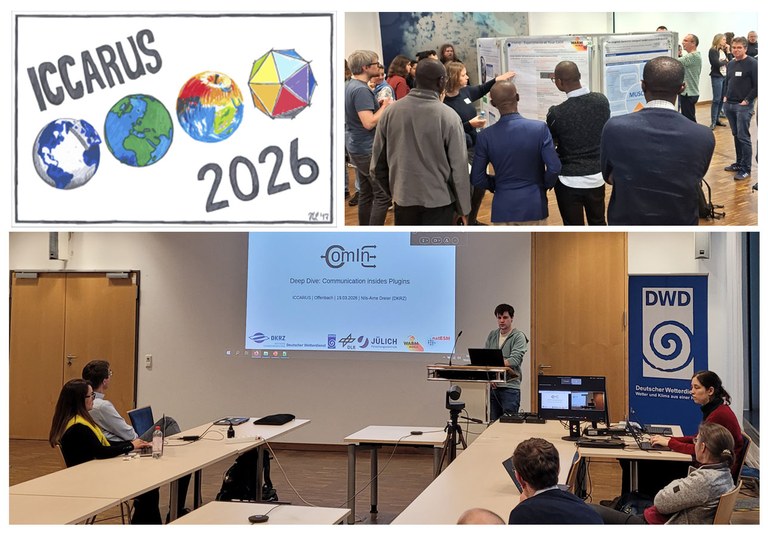
On Friday Claudia Frauen, Georgiana Mania, and Pradipta Samanta organized a full-day workshop to introduce ICON developers to C++ and the portability library Kokkos and how it can be used in ICON (see photo on the right, copyright: Vera Schemann). More than 70 participants either in person or following online joined for introductory talks, presentations on first examples in ICON, and lively discussions. This will hopefully be the starting signal for a wider uptake of C++/Kokkos by the ICON community. The workshop material is online available: Workshop " Performance portability with C++/Kokkos in ICON"
A third workshop, organized by Jan Frederik Engels and open only to invited participants, brought together ICON developers from all partner institutions. They discussed how established and widely accepted development workflows could be adopted. The goal is to simplify development and to eventually being able to incorporate contributions to the code from the wider community.
Overall, ICCARUS 2026 provided a structured setting for exchange between model developers, users and infrastructure experts. The contributions from DKRZ reflected the centre’s role in supporting the adaptation of climate and weather models to evolving high-performance computing environments.
Further information about ICCARUS 2026: www.dwd.de/iccarus

Onsite attendees of ICCARUS 2026 in Offenbach (copyright: DWD).