08.10.2026
What do a smartphone and a supercomputer have in common? More than you might think. With questions like these, 46 participants joined the DKRZ’s 10th Python Course for Geoscientists this week to explore the world of scientific programming. From 5 to 9 October, participants from countries including the Netherlands, Uganda, Japan and Mexico are learning online how Python can be used to analyse, process and visualise geoscientific data.
Looking beyond Python itself and exploring what happens under the hood, the course tackles questions like: What distinguishes an HPC system from a mobile device? How do processors, memory and software work together? And how does a piece of code become an executable program? The differences between compiled programs and interpreted languages such as Python are also discussed.
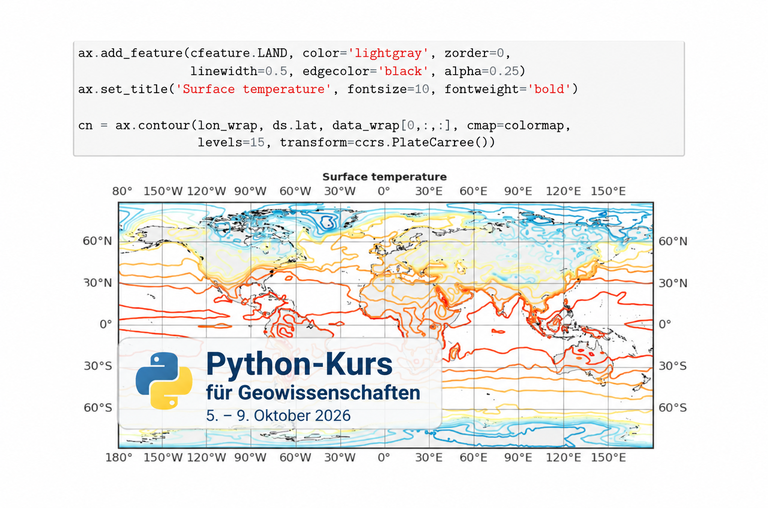
The course is aimed at both beginners and experienced programmers who want to apply their skills to working with scientific data. The programme covers the basics of Python as well as working with JupyterHub and JupyterLab. Participants then explore topics including NumPy, Xarray and data visualisation. Practical exercises take them from their first “Hello World” to the analysis of complex datasets.
Held via video conference, the course also enables exchange across national borders. For the participants, the days are filled with reading data, writing code and tracking down errors – and perhaps occasionally discovering that even a supercomputer does not automatically know what you want it to do.

Further information and the full course programme are available on the event page.