22.09.2026
The S2S2D conference brought together the international research community working on climate and Earth system prediction across timescales ranging from weeks to decades.

Over five days, researchers, operational prediction centres, and users exchanged recent advances and discussed future directions in subseasonal-to-decadal prediction. The scientific programme covered topics including predictability and prediction skill, physics-based prediction systems, climate services, and the rapidly developing role of machine learning in Earth system prediction.
A particular strength of S2S2D was bringing together communities working across traditionally distinct prediction timescales. Parallel subseasonal-to-seasonal (S2S) and seasonal-to-decadal (S2D) sessions were complemented by joint sessions addressing cross-cutting scientific challenges. Lively and highly interactive poster sessions provided further opportunities for scientific exchange, discussion, and networking.
The conference also highlighted the importance of translating advances in prediction science into information that benefits society, supporting preparedness for high-impact weather and climate events and strengthening climate services and decision-making.
The successful week in Reading demonstrated the vitality of the S2S2D community and created valuable opportunities for new collaborations. For the ESMO IPO at DKRZ, the conference was a major community event and an opportunity to foster international collaboration in Earth system prediction.

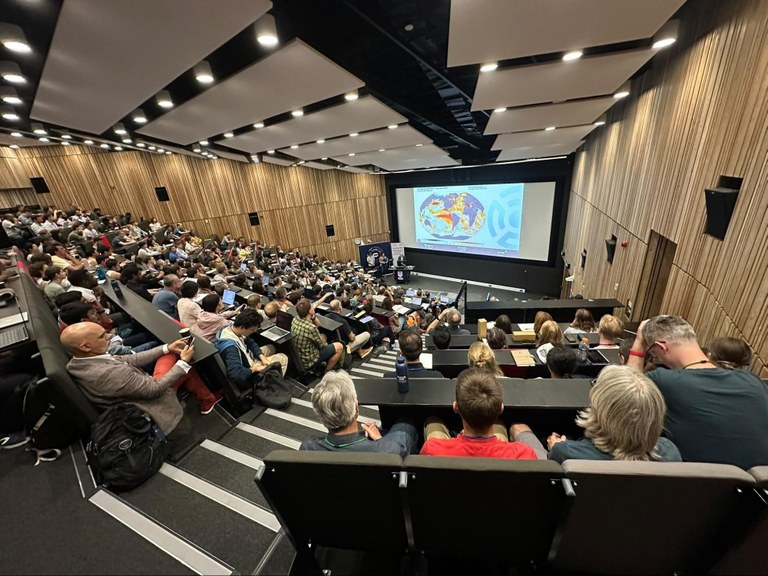
Attendees of the 3rd International Conference on Subseasonal to Seasonal to Decadal Prediction (S2S2D) that took place at the University of Reading, UK.