30.10.2026
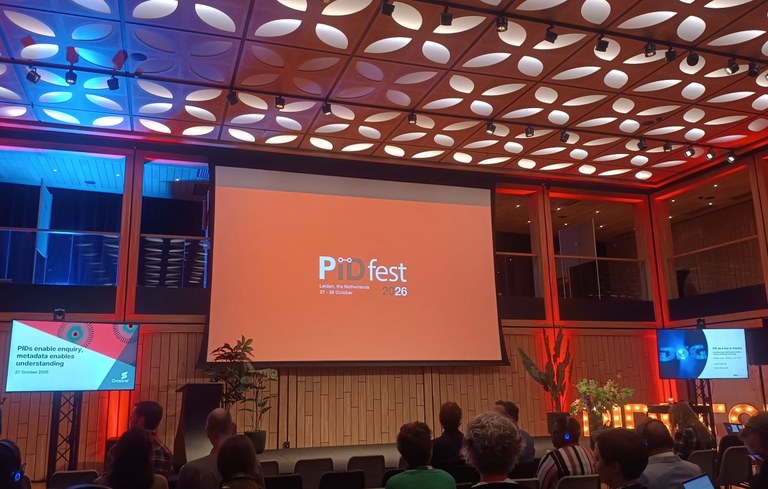
PIDfest is an international conference bringing together PID advocates, users and infrastructure leaders from research institutions and data infrastructures to address challenges in developing and implementing Persistent Identifiers (PID). PIDs are globally unique, persistent references to digital objects such as datasets, publications or files. They remain stable even if a resource’s location changes. PIDs support the FAIR principles: data should be findable, accessible, interoperable and reusable.
DKRZ colleagues contributed two discussion sessions and two posters on PIDs and their role in connecting research data, high-performance computing (HPC) and artificial intelligence (AI).
Persistent Identifiers for scalable data infrastructures and HPC workflows
Two discussion sessions led by the DKRZ team explored how PIDs support the discovery and reuse of scientific data. The session “What Deserves a PID?” addressed the appropriate level of detail for assigning PIDs: while collection- or dataset-level identifiers may suffice for discovery and citation, file-level identifiers can enable reproducibility and automated workflows. The challenge is balancing these benefits against management overhead. The discussion highlighted that PID assignment depends on the specific use case. For complex and evolving research workflows, approaches such as RAIDs, project identifiers, PID versioning, and RSpace were discussed. Participants agreed that, following the “FAIR-by-design” principle, a clear strategy for assigning PIDs throughout the research lifecycle should be established from the outset of a project.
The second session “Exploring PID applicability to HPC and AI Workflows” focused on integrating the creation of PIDs into HPC workflows, potentially during simulation runtime. Datasets generated at HPC centres often lack globally resolvable identifiers, limiting their discoverability and reuse. Discussions revolved around scalability of automated data access through agents, enabling discovery in federated data catalogues and the opportunity of data deduplication when all produced datasets are assigned a PID and hence searchable.
Interoperability with infrastructures such as the European Open Science Cloud (EOSC) and Destination Earth (DestinE) was also discussed, since these capabilities are particularly relevant for AI applications requiring access to training data across institutional boundaries.
FAIR Digital Objects and decentralized storage
DKRZ also presented two posters combining the FAIR Digital Object (FDO) concept with decentralized file storage using the InterPlanetary File System (IPFS). FDOs make digital resources and their metadata identifiable and machine-actionable. Combined with decentralized storage, they offer opportunities for resilient infrastructures beyond a single storage location.
Poster for Download:
- Interplanetary File System plus FAIR Digital Objects: Making Campaign Data Findable and Verifiable (1.8 MB)
- STAC as FDO: From Standard to Future Data Infrastructure (2.2 MB)
Together, the DKRZ contributions highlighted the importance of PIDs for connecting scientific data, computing infrastructures and automated workflows. As HPC-generated datasets become increasingly relevant to research and AI, reliable identification and interoperability are essential for reuse across institutional boundaries. The event provided an opportunity to exchange ideas and advance FAIR research infrastructures.
