23.11.2026
The ECMWF Workshop on Software Strategies for Sustainable Physical Modelling (23–27 November, Reading, UK) brings together experts to explore how scientific software can adapt to emerging HPC architectures and new programming paradigms.
DKRZ researcher Georgiana Mania has been invited to deliver a keynote titled “Enabling Performance Portability in ICON with C++/Kokkos: The Ragnarok Approach”. Her talk will introduce how the Ragnarok project aims to modernise ICON for increasingly heterogeneous supercomputing architectures.
Rethinking How ICON Runs – Bringing C++ into ICON
ICON already runs on conventional processors as well as on GPUs from NVIDIA and AMD. However, supporting these different architectures requires thousands of additional instructions to be embedded throughout the code. This makes the model increasingly difficult to maintain and adapt. The challenge is growing as new supercomputers emerge. For example, the upcoming Alice Recoque system, based on AMD MI430X GPUs, will not support the OpenACC technology currently used in ICON's Fortran code. Without changes, ICON would lose its ability to use this type of hardware efficiently.
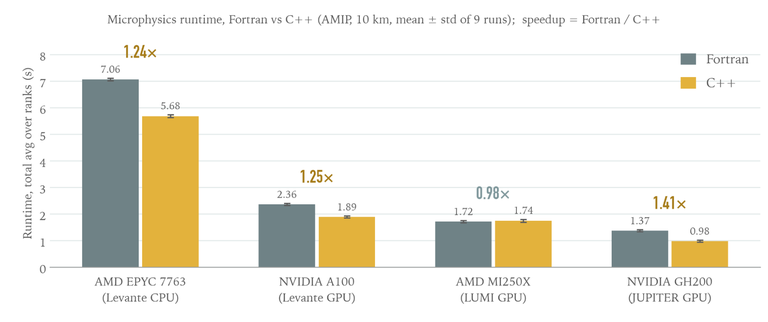
The Ragnarok approach addresses this challenge by taking a different route. Following a comparative study of several programming technologies applied to the graupel microphysics scheme, Kokkos emerged as a particularly promising solution, achieving a performance portability score of 0.95. Kokkos is an open-source C++ library that helps scientific applications run efficiently across different hardware architectures. Its open governance and support through the High Performance Software Foundation also provide a strong foundation for long-term development.
Since October 2024, ICON has been adopting Kokkos as part of the WarmWorld project, with the aim of modernising its physical components one at a time. Rather than rewriting the entire model, the team is following an incremental approach: existing Fortran components remain in place and work alongside newly developed C++ components, ensuring that operational runs can continue without disruption. This effort is called “Ragnarok”, marking the end of an era dominated by Fortran.

Towards Hardware-Independent Climate Modelling
The move to Kokkos is not just about preparing ICON for future hardware. It is also making the code easier to maintain and develop: the new C++ graupel scheme is 28% less complex than its predecessor. Automated tests and full ICON simulations help ensure that these changes preserve scientific accuracy.
With microphysics and thermodynamics already migrated, the team is now extending the approach to vertical diffusion and radiation, gradually bringing more of ICON onto a common, portable software foundation.
Link to the event: https://events.ecmwf.int/event/529/overview
Link to the project: https://warmworld.de/
Contact: Georgiana Mania