02.11.2026
The new module builds directly upon the success of the first project phase, especially the Faster module, which, among other achievements, enabled Earth system simulations with a resolution of 1 kilometer for the first time. Hail Mary takes a decisive step further: it aims to run ICON simulations at a significantly higher global resolution – targeting down to 150 meters. This represents an enormous technical challenge and a crucial step toward answering long-standing scientific questions regarding how clouds respond to global warming and changes in aerosol forcing.
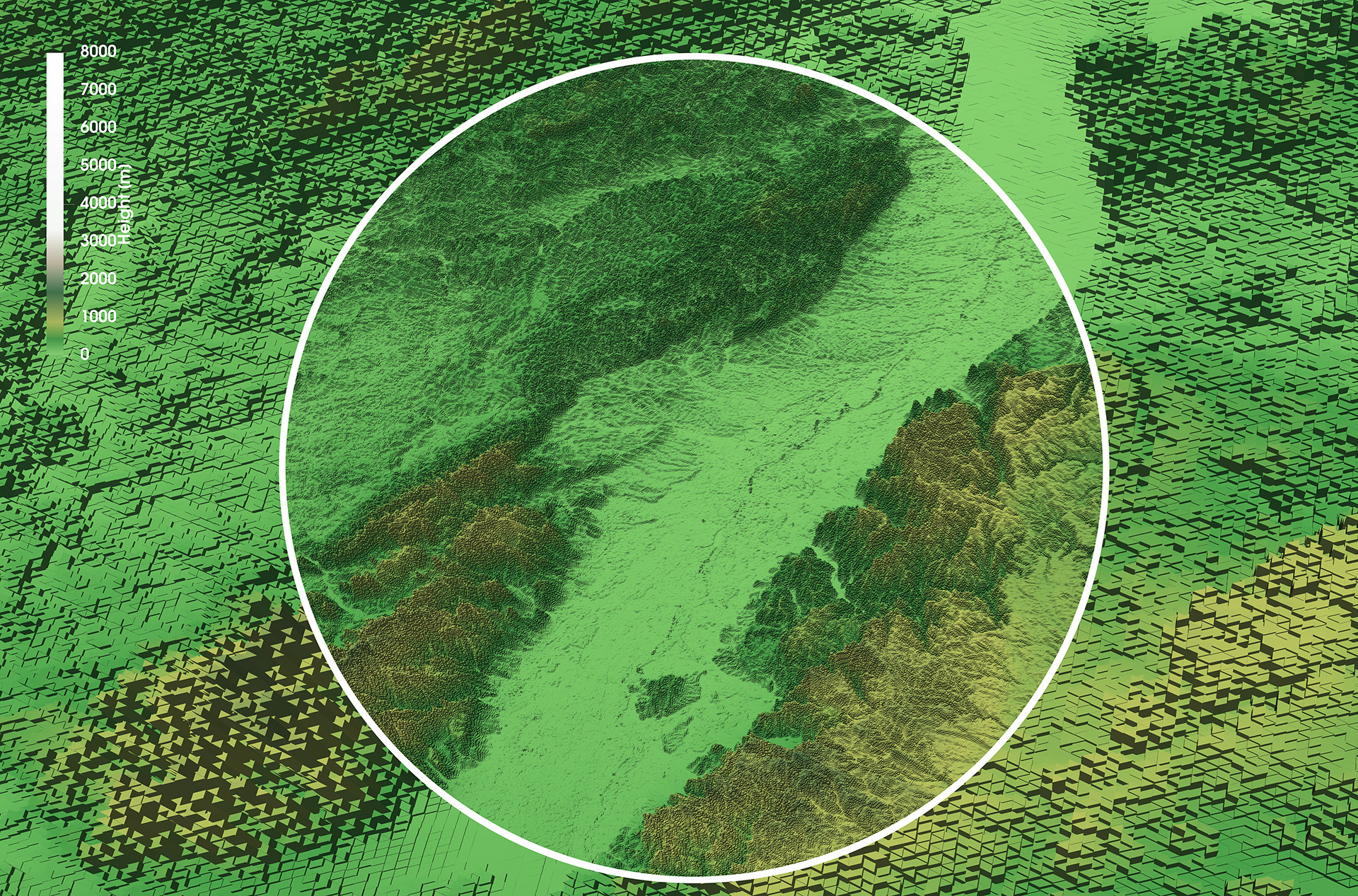
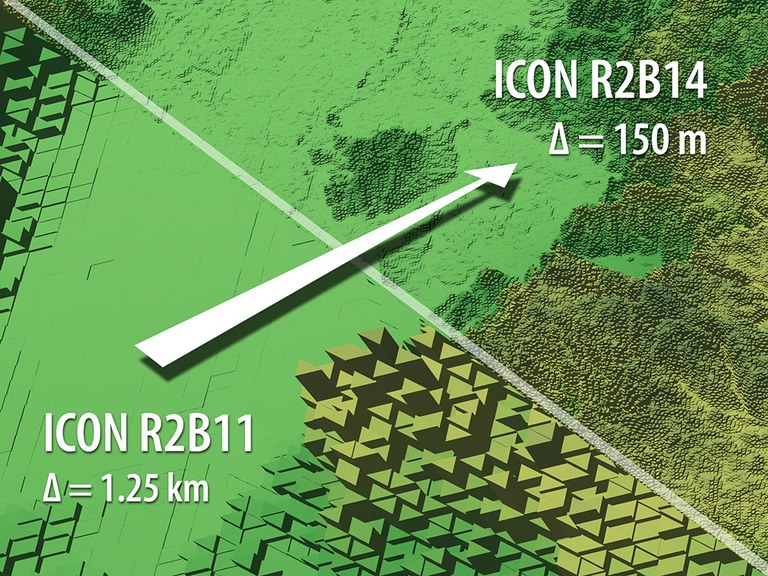
Figure 1: The visualization shows the topography of the ICON R2B11 model outside the circle. At 1.25 km, this is the highest global horizontal resolution achieved to date with an Earth system model. The “Hail Mary” subproject of WarmWorld2 aims to achieve a global resolution of 150 m (shown within the circle for illustrative purposes). The map section shows the Rhine Valley Graben as viewed from the south looking north; the Kaiserstuhl can be seen in the circle in the foreground of the Rhine Valley.
Key tasks for achieving this goal include improving performance portability and memory usage efficiency. The existing code is written in Fortran and uses OpenACC directives for GPU offloading; however, limited compiler support for this approach means the model cannot be executed across all hardware architectures. Consequently, significant portions of the model will be rewritten in C++ within Hail Mary using the portability library Kokkos.
In order to be able to load model configurations at such high resolutions into the memory of supercomputers, memory must be used much more efficiently. A major contribution to this effort involves transitioning the model’s data structures and calculations - where numerically justifiable - from double-precision (64-bit) to single-precision (32-bit) floating-point arithmetic. Furthermore, the memory manager library developed in the preceding module Faster is being expanded and used to optimize memory efficiency.
In addition, a new library for the model’s grid infrastructure is being developed with the goal of making the software more organized, easier to maintain and extend, and capable of supporting extremely high-resolution grids. The model’s build and test infrastructure is also being further developed to enhance user-friendliness, thereby supporting the evolution of the ICON model toward an "open development" approach.
The planned developments for the ICON model are essential adjustments required to enable ambitious future scientific experiments. Other modules within the second phase of the WarmWorld project - "Run Baby Run" and "Go with the Flow" - will also benefit from these enhancements. These two additional modules are scheduled to start in the spring of 2027, ensuring that the overall WarmWorld project continues to drive cutting-edge research for another three years.

Grant reference number: 01LK2203A1