21.07.2026

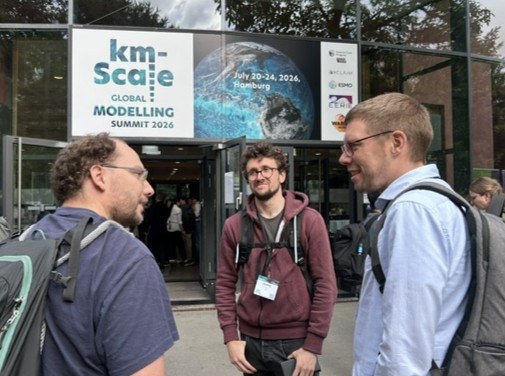
Around 350 experts in climate science, HPC, and artificial intelligence (AI) have gathered at Bucerius Law School in the heart of Hamburg from 20–24 July 2026 to discuss the rapid scientific and technological advances in high-resolution Earth system modelling.
At the heart of the summit is the question of how future global kilometer-scale Earth system models can represent physical processes more realistically while running efficiently on exa-scale supercomputers - and what role AI will play in achieving this. For DKRZ, this is a central topic, as scientific progress and cutting-edge computing infrastructure come together.
Through its contributions, DKRZ covers the entire lifecycle of modern Earth system simulations — from model development and running the models efficiently on supercomputers to the provision of analysis-ready datasets. The scientific contribution by Etor E. Lucio-Eceiza also received special recognition: With his poster “From multiscale climate extremes to impact assessment: scientific insights and climate services”, he was awarded joint first place in the Summit’s Best Poster Award.
New insights into the Ocean: First extended HAMOCC simulation at 2.5 km resolution
A particular highlight of the summit is the presentation of the first longer ICON simulations including the Hamburg Ocean Carbon Cycle Model (HAMOCC). This marks the first time the carbon cycle — both on land and in the ocean — has been simulated at a global resolution of 2.5 kilometers. This allows climate researchers to explicitly resolve the response of the carbon cycle to mesoscale processes in the ocean, even in high latitudes.
The simulations, which have been run by David Nielsen of the Max Planck Institute for Meteorology (MPI-M) in collaboration with the University of Hamburg and ETH Zurich, was prepared in several visualizations just in time for the event by Michael Böttinger (DKRZ). As the biogeochemical component of the ICON Earth system model, HAMOCC simulates material cycles within the ocean and their interactions with sediments and the atmosphere.
The new visualizations of the HAMOCC/ICON simulations are also available on the DKRZ YouTube channel.

Carbon export at 90m depth and ocean currents simulated with ICON at 2.5km resolution (Simulation: David Nielsen et al., MPI-M/ETH/UHH; Visualization: Michael Böttinger, DKRZ)
At the DKRZ booth, these and other kilometer-scale simulation results are presented on a climate globe and an interactive touch table. The visualizations demonstrate how high-resolution Earth system models are increasingly becoming powerful tools for making complex interactions within the Earth system visible and accessible for scientific analysis. They highlight the scientific potential of kilometer-scale modeling and the new research opportunities these simulations create for climate science.
A Summit Built on Collaboration
The km-scale Global Modelling Summit is part of a broader scientific effort. It builds on the achievements of projects such as DestinE, EERIE, nextGEMS, WarmWorld, and other German and European initiatives, while advancing the vision of the Earth Virtualization Engines (EVE): making high-resolution climate information accessible to everyone. This vision has evolved into a growing international community working together to advance Earth system models, software, and data infrastructures.
An important element of this collaboration is the series of Global km-Scale Hackathons organised under the World Climate Research Programme (WCRP) and coordinated by Earth System Modelling and Observations (ESMO). Last year, researchers gathered simultaneously at ten locations worldwide — including Hamburg — to work together on kilometer-scale modeling challenges. The next hackathon is scheduled for June 2027.
Immediately before the summit, around 50 scientists met at MPI-M from 16–18 July for a three-day hackathon. The event focused on evaluating the outcomes of the 2025 Global km-Scale Hackathon and preparing the next edition in 2027. Events like these strengthen international collaboration and help translate scientific innovations more rapidly into operational Earth system modelling.
Whether through high-performance computing, data management, or the visualization of high-resolution simulations, DKRZ provides the infrastructure that enables kilometer-scale Earth system models to be developed and deployed on future exa-scale systems. The summit demonstrates how closely scientific research and research infrastructures such as DKRZ work together to advance the next generation of climate modelling.
Aftermovie km-Scale Summit.
Further information
The km-scale Global Modelling Summit is funded by several scientific projects, including WarmWorld, supported by the German Federal Ministry of Research, Technology and Space (BMFTR), the EU-funded project EERIE, and the EXCLAIM project funded by ETH Zurich’s Open ETH programme. The Max Planck Institute for Meteorology is the local host and one of the sponsors of the event.
- Website of the km-scale Global Modelling Summit: https://km-scale-summit-26.org/
- Program
Summit Contributions of the DKRZ Team
Talks
- Field-Space Transformers for Physically Consistent Kilometer-Scale Climate Modeling (Maximilian Witte, presented by Christopher Kadow), Mon, July 20 at 11:55 a.m.
- A HEALPix-Zarr-S3 data hub for analysis and AI-ready Earth system data (Martin Bergemann), Mon, July 20 at 12:20 p.m.
- Field-Space Autoencoders for Scalable Climate Data Compression and Generative Emulation (Johannes Meuer), Tue, July 21 at 9:45 a.m.
- ICON’s Journey to Exascale: Lessons in Performance Portability for Kilometer-Scale Climate Modeling (Claudia Frauen), Thu, July 23 at 9:30 a.m.
- Code Meets Climate: The Ragnarok Blueprint for Performance-Portable ICON (Georgiana Mania), Thu, July 23 at 11:55 a.m.
Posters
- Confronting vertical cloud structures in a km-scale climate model with ground-based observations from ACTRIS stations (Paula Bigalke, Vera Schemann, Bernhard Pospichal, Siddhant Tibrewal, Nils-Arne Dreier, Karl-Hermann Wieners), Tue, July 21, 2:00–3:30 p.m.
- ClimateClaw: From Natural Language to Reproducible Climate Analysis (Gizem Ekinci, Koketso Molepo, Sebastian Willmann, et al.), Tue, July 21, 2:00–3:30 p.m.
- The Petabyte Prompt (Christopher Kadow, Gizem Ekinci, Maximilian Witte, et al.), Tue, July 21, 2:00–3:30 p.m.
- Towards Integrating Simulations and Observations with Graph Neural Networks (Étienne Plésiat, Johannes Meuer, Maximilian Witte, et al.), Tue, July 21, 2:00–3:30 p.m.
- From multiscale climate extremes to impact assessment: scientific insights and climate services (Etor E. Lucio-Eceiza, Christopher Kadow, Jens Grieger, et al.), Wed, July 22, 2:00–3:30 p.m.
- Resolving the impact of extreme km-scale storms on the ocean carbon sink (David Nielsen; Cathy Hohenegger; Nicolas Gruber; Michael Böttinger et al.), Wed, July 22, 2:00–3:30 p.m.
- From HPC Storage to Analysis: Zarr Streaming Climate and km-Scale model data from Levante (Martin Bergemann, Mostafa Hadizadeh, Etor Lucio Eceiza, et al.), Thu, July 23, 2:00–3:30 p.m.
- Runtime Data Access for km-scale Climate Models (Nils-Arne Dreier, Florian Ziemen), Thu, July 23, 2:00–3:30 p.m.
- Curating km-scale earth system model simulation data along its lifecycle (Kameswar Rao Modali, Karsten Peters-von Gehlen, Dogus Kaan Bilir, et al.), Thu, July 23, 2:00–3:30 p.m.
- A look into the NetCDF Zarr implementation (Manuel Reis), Thu, July 23, 2:00–3:30 p.m.
- Achieving Performance Portability for the Math Library in ICON with C++/Kokkos (Pradipta Samanta), Thu, July 23, 2:00–3:30 p.m.
- Hiopy: Creating Analysis-Ready Dataset from km-Scale ICON Climate Model (Nils-Arne Dreier, Siddhant Tibrewal), Thu, July 23, 2:00–3:30 p.m.
- The km-scale-cloud: How to Access and Analyze km-Scale ESM Output Across DKRZ's Storage Systems (Fabian Wachsmann, Chathurika Wickramage, Andrej Fast, et al.), Thu, July 23, 2:00–3:30 p.m.
- Making Kilometer-Scale Earth System Model (ESM) simulations usable: A workflow approach from European Eddy Rich ESMs (EERIE) project (Chathurika Wickramage, Fabian Wachsmann, Jürgen Kröger, et al.), Thu, July 23, 2:00–3:30 p.m.
- Making km-scale modeling easier (Florian Ziemen, Vera Schemann, Team WarmWorld EASIER), Thu, July 23, 2:00–3:30 p.m.
- Implementing Reduced Precision in the ICON Model (Dylan Kierans, Angel Peinado), Thu, July 23, 2:00–3:30 p.m.