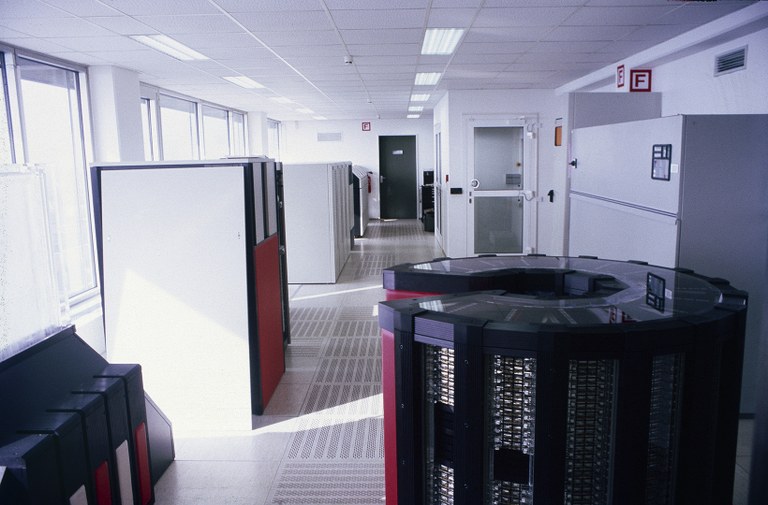
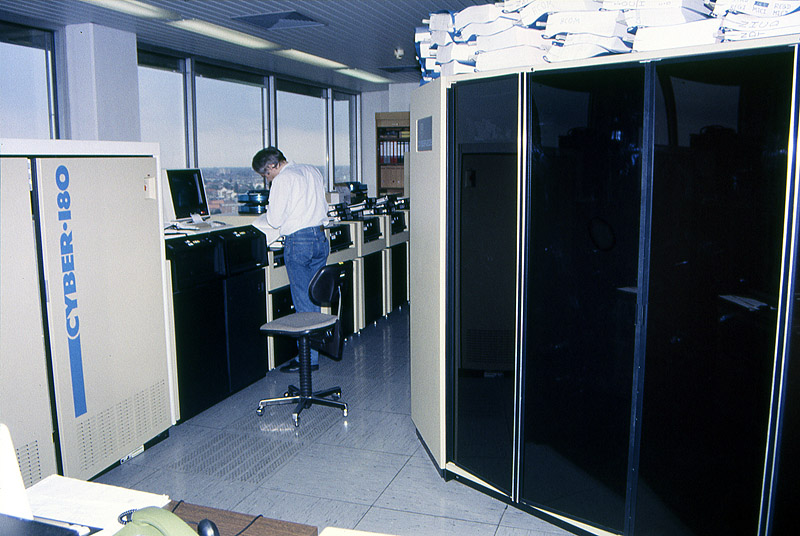
 In 1987, a national climate computing center, DKRZ, was established in Germany as a central service facility to meet the rapidly growing computational demands of the climate research community. It evolved from the joint computer center of the Max Planck Institute for Meteorology (MPI-M) and the University of Hamburg.
DKRZ was organized as a non-profit limited company. Its first scientific director was Klaus Hasselmann, also director at MPI-M; the first technical director was Wolfgang Sell. Major investments for the facility were provided by the Federal Ministry of Education and Research (BMBF). The operations were funded jointly by BMBF and the company’s four shareholders, the Max Planck Society for the Advancement of Sciences, the Freie und Hansestadt Hamburg represented by the University of Hamburg, the GKSS Research Centre (today: Helmholtz-Zentrum Geesthacht - Centre for Materials and Coastal Research), and the Alfred Wegener Institute for Polar and Marine Research. DKRZ's staff grew from initially 12 to 55 including personnel funded by research grants.
Around the year 2000, DKRZ was significantly restructured for organizational and financial reasons. The teams involved in specific model and data support were separated from DKRZ and administered under the name "Model and Data" by the MPI-M in Hamburg. DKRZ and its remaining staff members concentrated on the operation of the supercomputing facility and the associated services. Prof. Dr. Guy Brasseur was appointed as the new director at MPI-M and the new scientific director of DKRZ.
In 2009 and 2010, further significant changes took place. As an important step to better integrate DKRZ into the scientific landscape, a new director, Thomas Ludwig, was appointed. At the same time, he was also appointed full professor for computer science at the University of Hamburg. DKRZ moved into a newly renovated building funded by the City of Hamburg, and the Model & Data group was reintegrated. Today, DKRZ has more than 70 staff members and is structured into four departments: Applications, Data Management, Systems, and Administration.